
What Does an ADHD Coach Do? (And How They Help)
 The Nurtured Coach Faculty· 16 June 2026 · 6 min read
Accredited training · The Spectrum Council
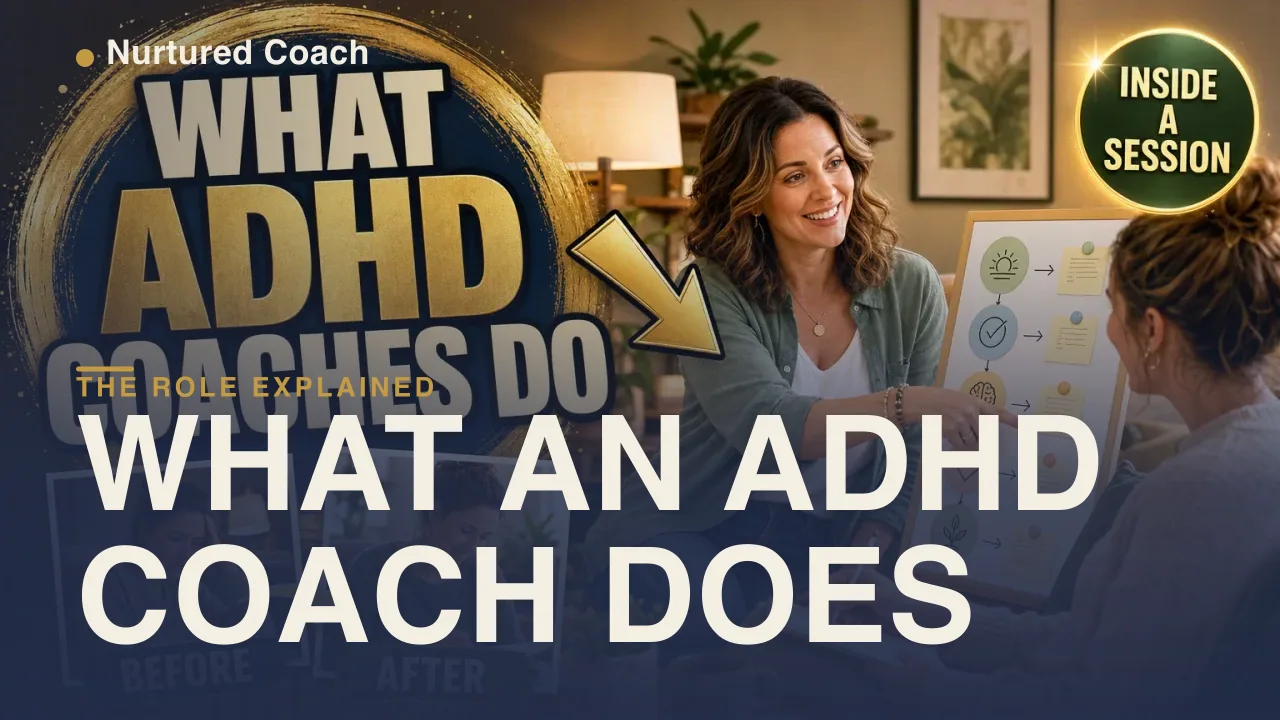
When people ask what does an ADHD coach do, the most honest answer is this: an ADHD coach is a structured thinking partner who helps neurodivergent adults build practical strategies for focus, time, organisation and emotional regulation — then holds them accountable while those strategies take root. They are not clinicians, and they don't diagnose or treat ADHD. Getting this distinction right matters because the wrong kind of help can leave someone spinning in shame, out of pocket, and no closer to a life that works.
ADHD adults are statistically more likely to experience burnout, chronic underachievement and damaged self-esteem — often after years of being told they're lazy or not trying hard enough. The right coach can interrupt that cycle. The wrong one — or no help at all — can deepen it.
What Does an ADHD Coach Do, Day to Day?
ADHD coaching is collaborative and relentlessly concrete. A coach doesn't lecture or hand you a worksheet to fill in alone. They sit with you — virtually or in person — and help you unpick the real friction points in your life, then design systems that actually fit how your brain works.
A typical session might include:
- Checking in on what's worked and what's collapsed since last time — without judgment
- Picking a real focus — a stuck project, a chaotic morning routine, an avoided email pile that's become a source of dread
- Designing a strategy together — breaking the task down, externalising the steps, removing hidden friction
- Setting a small, doable commitment — and deciding in advance how to make follow-through easier
- Reflecting on patterns — so the client slowly builds self-knowledge rather than just surviving week to week
The emphasis is always on *experimentation*, not perfection. A coach helps you run a small test, notice what happened, and adjust. That loop — try, observe, refine — is the engine of the work.
It's Not About Willpower
This is perhaps the most important thing to understand about what an ADHD coach does: they don't teach you to "try harder." The ADHD brain doesn't respond reliably to willpower, and framing it that way is one of the fastest routes to burnout and shame.
Instead, a coach works *with* the ADHD nervous system:
- Externalising tasks and time — so working memory isn't the bottleneck
- Scaffolding routines and environments — building structure around you rather than relying on internal discipline
- Working with motivation, interest and urgency — designing tasks that harness what actually moves you, rather than fighting your neurochemistry
- Holding rejection sensitivity and self-criticism with care — because the emotional layer of ADHD is often the heaviest one
What an ADHD Coach Does NOT Do
This boundary is not a footnote — it defines ethical practice. ADHD coaching is not treatment for anxiety, depression, trauma, eating disorders, or any clinical condition. A properly trained coach recognises when something falls outside their scope and refers the client to a therapist, psychiatrist, or other clinician.
Knowing — and holding — that line is exactly what accredited training drills into you. It's not a vague aspiration. It's a concrete professional standard, and it protects the client.
A well-meaning but untrained "coach" listens to a client describe childhood trauma and emotional dysregulation, then offers productivity tips and a morning routine. The client feels momentarily heard but the underlying wound goes unaddressed. Weeks later, the routine collapses — because the real barrier was never about time management.
An accredited ADHD coach hears the same description, gently names that the emotional content sounds like it belongs in a therapeutic space, and refers the client to a qualified therapist. Coaching continues to focus on the practical, present-day strategies — while therapy holds the deeper work. Both professionals stay in their lanes, and the client gets the right help from the right person.
Who Benefits From ADHD Coaching?
ADHD coaching helps people who understand *what* they want to do but consistently struggle with the *how*. That gap — between knowing and doing — is the lived experience of most ADHD adults, and it's exactly where a coach makes the biggest difference.
Clients come from every walk of life:
- Students navigating deadlines, revision and the transition to independent learning
- Professionals managing workload, meetings, email and workplace communication
- Entrepreneurs juggling multiple roles, projects and the chaos of running a business
- Parents trying to hold a household together while their own executive function is stretched thin
- Late-diagnosed adults processing a new identity and re-examining decades of "failure"
Many coaches specialise — women with ADHD, the workplace, late diagnosis, university students — which makes it easier for clients to find someone who understands their specific context. Specialisation isn't a marketing tactic; it's a recognition that ADHD shows up differently depending on the environment and life stage.
What Makes a Coach Worth Working With?
Not every "ADHD coach" is created equal. The field is largely unregulated, which means anyone can put up a website and start charging. So how do you tell the difference?
Look for:
- Accredited training — completion of a programme that meets recognised standards, such as those set by The Spectrum Council
- A clear scope of practice — a coach who can articulate what they do and, crucially, what they don't do
- Real client experience — not just lived experience of ADHD, but trained experience working with a range of clients
- Ethical grounding — confidentiality, boundaries, referral pathways, and an understanding of when coaching isn't the right intervention
Lived experience of ADHD can be a powerful asset in a coach. But it's not a substitute for training. The best coaches hold both — personal understanding and professional skill.
- Choosing a coach based solely on their own ADHD story — personal experience doesn't equal training, and can lead to one-size-fits-all advice that doesn't fit your brain
- Expecting coaching to replace therapy — if anxiety, depression or trauma are the primary barriers, coaching alone won't reach them and may even delay necessary treatment
- Treating the first session as a make-or-break test — good coaching is a relationship that builds over time; give it at least a few sessions before deciding whether the fit is right
How Coaching Differs From Other ADHD Support
People often confuse ADHD coaching with therapy, mentoring, or even tutoring. Here's a simple way to think about the differences:
| Support Type | Primary Focus | Time Orientation |
|---|---|---|
| Therapy | Emotional healing, clinical conditions | Past and present |
| ADHD Coaching | Practical strategies, accountability, systems | Present and future |
| Mentoring | Career guidance based on experience | Future-focused |
| Tutoring | Subject-specific skill-building | Task-specific |
Coaching lives in the *present and future*. It's about what you want to do next week, next month, and how you're going to actually get there. That forward momentum is what makes it so effective for ADHD adults who are tired of looking backwards.
What Happens Between Sessions
A huge part of what an ADHD coach does happens *between* sessions. The session itself is where you design the strategy, but the days in between are where it gets tested.
Good coaches build in lightweight accountability — not surveillance, but a structure that makes follow-through more likely. This might look like:
- A shared document where the client logs their daily commitment
- A check-in message at an agreed time
- A "minimum viable action" — the smallest possible version of the task that still counts
The goal isn't to create dependency. It's to build a scaffold the client gradually internalises, so that over time they need the coach less, not more.
The Emotional Side of the Work
ADHD coaching isn't therapy, but it's not emotionally neutral either. Many clients arrive carrying years of shame, self-blame and the residue of being told they're not living up to their potential.
A skilled coach holds that emotional reality without trying to fix it clinically. They name it, validate it, and then gently redirect the client's attention toward what's within their control. That balance — warmth without overstepping — is one of the hardest things to learn and one of the most valuable.
An ADHD coach is a trained, ethical thinking partner who helps you build systems that fit your brain — not a clinician, and not a cheerleader. The right coach works with your neurochemistry, not against it, and knows exactly when to refer you to someone else.
Want to Do This Work?
If this sounds like the kind of help you'd love to give — the kind that changes how people experience their own lives — there's a clear path forward.
Start by reading how to become an ADHD coach for a grounded overview of the training journey. When you're ready to go deeper, explore the Certified ADHD Coach certification — accredited by The Spectrum Council and built around real client work, not just theory.
The world doesn't need more generic productivity advice. It needs coaches who understand the ADHD brain, hold professional boundaries, and know how to help people build lives that actually work. If that's you, the training is waiting.
Frequently asked questions
What does an ADHD coach do?
An ADHD coach helps clients build practical strategies for focus, time, organisation and emotion — designed around the client’s ADHD profile. They set goals, design systems collaboratively, and provide accountability, while staying clear of clinical treatment.
What is the difference between an ADHD coach and a therapist?
A therapist treats mental-health conditions and often works on the past; an ADHD coach is forward-looking and practical, focused on systems, goals and follow-through. A skilled coach knows the boundary and refers to a therapist when needed.
Try a free self-assessment
Quick, private, evidence-based screens — for understanding yourself or the clients you'll coach.
The Nurtured Coach Faculty
The Nurtured Coach Faculty design and teach our ADHD, autism, neuroscience and neurodiversity coaching certifications — every one independently accredited by The Spectrum Council. We write these guides from the same material we use to train working coaches.