
How to Become an ADHD Coach: Step-by-Step Guide (2026)
 The Nurtured Coach Faculty· 10 June 2026 · 9 min read
Accredited training · The Spectrum Council
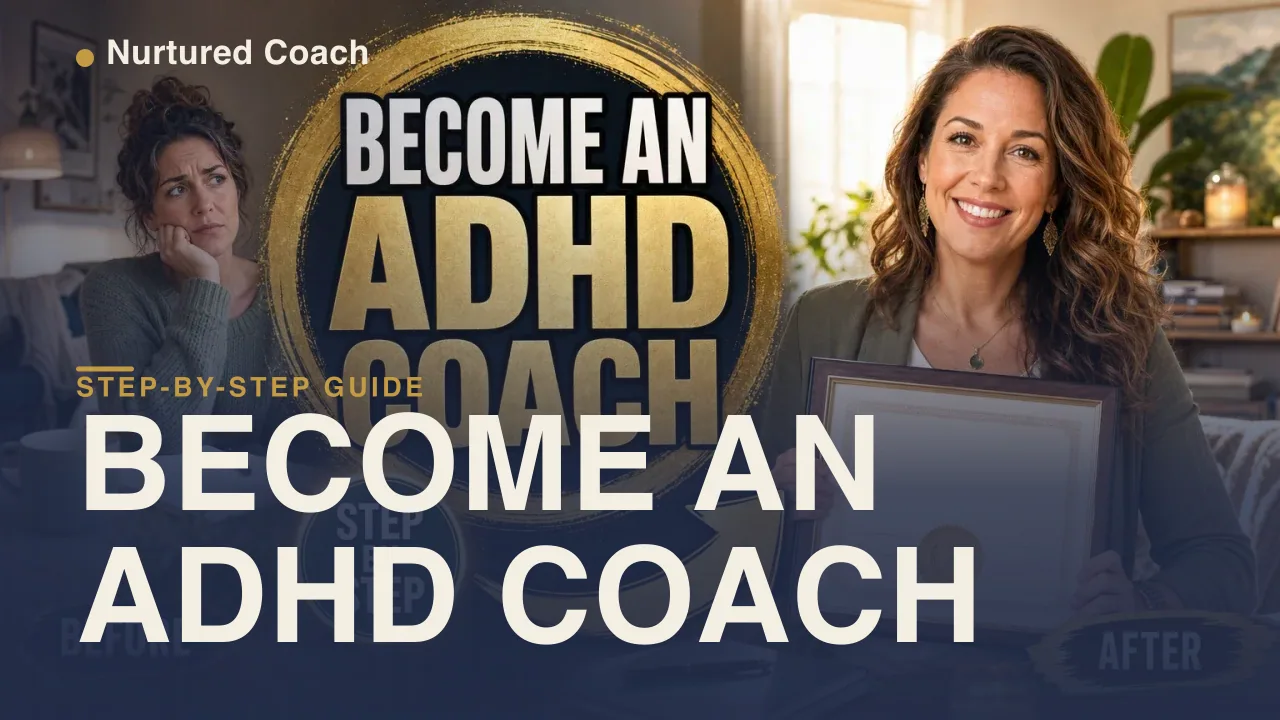
Learning how to become an ADHD coach means training to help people work *with* their brains instead of against them — building practical systems for focus, time, emotion and follow-through. You don't need a clinical degree, but you do need genuine understanding of how ADHD works and a structured, ethical method you can stand behind. Getting this right matters because clients come to you at their most vulnerable — and the difference between a well-trained coach and a well-meaning amateur is whether someone rebuilds their self-trust or walks away feeling more broken than before.
ADHD coaching sits in a grey space between clinical care and general life coaching. If you train properly, you become the person who helps a client finally finish what they start, manage their emotions, and trust themselves again. If you don't, you risk giving advice that backfires, missing red flags that need referral, or reinforcing the shame your client already carries.
What does an ADHD coach actually do?
An ADHD coach is a thinking partner — not a therapist, not a tutor, not a productivity guru. You help clients design strategies that fit how *their* mind works: externalising tasks, scaffolding routines, navigating rejection sensitivity, and slowly rebuilding the self-trust that years of missed deadlines and broken promises have worn away.
The work is collaborative. You don't hand someone a planner and say "use this." You sit with them, figure out why their previous systems collapsed, and co-design something that has a fighting chance of surviving a bad week.
Crucially, you also know where coaching ends and clinical care begins. If a client is describing trauma, severe depression, or suicidal ideation, your job is to recognise that and refer on — not to coach through it. That boundary is the first thing any good training should teach. (More on the day-to-day role in What does an ADHD coach do?)
The core skills you'll develop
- Executive function support — helping clients externalise time, break tasks into doable chunks, and build transition rituals
- Emotional regulation coaching — working with rejection sensitive dysphoria, frustration tolerance, and the shame cycle
- Collaborative system design — building tools *with* the client, not for them
- Ethical boundary-setting — knowing your scope and referring when something is outside it
- Contracting and trust — establishing a clear coaching agreement so both of you know what you're doing and why
Do you need certification to become an ADHD coach?
Here's the uncomfortable truth: coaching is unregulated. Anyone can print a business card that says "ADHD coach" tomorrow morning.
That freedom cuts both ways. It means the barrier to entry is low — but it also means clients have no reliable way to tell a trained coach from someone who read a book and set up a website. Certification is how you bridge that gap.
A credential that is accredited by an independent body and verifiable on a public register carries real weight. It tells clients that someone other than you has checked your work. It also tells *you* that you've been held to a standard — which, on the days you're doubting yourself, matters more than you might think.
A well-meaning person with lived ADHD experience sets up a coaching Instagram, starts charging clients, and offers strategies based entirely on "what worked for me." Within months, a client presents with signs of severe depression. The coach, with no training in scope or safeguarding, tries to coach through it — and the client's situation worsens.
That same person enrols in an accredited ADHD coach training programme. They learn the boundary between coaching and clinical care, practise referring on, and develop a method that adapts to each client rather than imposing a single template. When the same situation arises, they recognise the red flags, refer the client to appropriate clinical support, and continue coaching the parts that are genuinely within their scope.
How to become an ADHD coach: the step-by-step path
Step 1 — Choose training that covers the full picture
Not all ADHD coach training is created equal. A weekend webinar on "ADHD tips" is not training. Look for a programme that covers:
- How ADHD affects executive function, time perception, emotion and motivation
- The coaching relationship — contracting, trust, boundaries, and what to do when things go sideways
- Designing tools *with* the client, not for them
- Working with rejection sensitivity and emotional dysregulation
- Scope, ethics and safeguarding — when and how to refer on
- Building your actual practice — finding clients, setting fees, staying sustainable
The Certified ADHD Coach certification is built around exactly these six areas. It's self-paced, with 23 hr 55 min of core lessons, plus assessed practice and a capstone, and is accredited by The Spectrum Council.
Step 2 — Complete your training and assessment
Real certification ends with demonstrated competence — not a multiple-choice quiz you can retake until you pass. Look for a capstone or assessed coaching session where you show you can actually hold a coaching conversation, contract ethically, and adapt to a real person's needs.
This is the point of the whole process, not a hurdle to clear. If your training doesn't assess your coaching, it's teaching you about coaching — not training you to do it.
Step 3 — Get certified, registered and verifiable
On passing, you should earn two things: a credential and a public register entry with a permanent registration number. That verifiable record is the difference between "I did a course" and "here is my accreditation, you can check it in one click."
Clients are getting savvier. Many now ask for your registration number before booking. Having one — and being findable on an independent register — removes their doubt before it even becomes a question.
Step 4 — Get your first clients
You don't need a huge audience to start. You need a clear niche and a way to be found.
The most effective new ADHD coaches tend to lead with something specific:
- Lived experience — "I was diagnosed at 38 and I coach other late-diagnosed adults"
- A tight specialism — women with ADHD, university students, professionals in the workplace, parents
- A simple referral approach — one or two relationships with diagnostic clinics, therapists, or ADHD charities that trust you and send people your way
Good certifications include client-attraction training so you're not starting from zero. You should finish your course knowing how to describe what you do, who you do it for, and how to have a first conversation that doesn't feel like a sales pitch.
- Choosing training with no assessment — you finish with a certificate but no proof you can actually coach, and clients can tell
- Skipping ethics and scope training — this is where preventable harm happens, and it's the module most people want to rush through
- Trying to coach everyone — a vague niche means vague marketing, which means no clients; specificity is what fills your first slots
- Waiting until you "feel ready" — competence comes from coaching real people with supervision, not from re-reading your notes
What does it cost — and is it worth it?
Quality ADHD coach training has historically cost hundreds to thousands of pounds. Self-paced, accredited certification has made it far more accessible — the Certified ADHD Coach course is £77 (reduced from £392), includes bonuses, and comes with this refund policy: Full refund within 30 days if you have not sat the final exam..
Whether it pays off depends on you — your effort, your niche, your willingness to put yourself in front of people. But ADHD coaching is one of the few helping careers you can train for in weeks, practise from anywhere, and build around your own neurodivergent life. For realistic figures on what coaches earn, see ADHD coach salary.
How long does it take?
With a self-paced programme, most people complete their training in 4–8 weeks alongside a job or other commitments. The assessed element — usually a capstone coaching session — happens when you're ready, not on a fixed exam date.
That said, becoming a *good* ADHD coach is a longer journey. Your training gives you the method and the ethics. Your first 20 clients teach you the craft. Supervision, peer support, and continuing professional development keep you sharp. The credential is the start of the road, not the end of it.
Who makes a good ADHD coach?
You don't need a clinical background. You don't need to be neurodivergent yourself, though many ADHD coaches are. What you do need is:
- Genuine curiosity about how different brains work — not a one-size-fits-all mindset
- Patience — progress in ADHD coaching is often non-linear, and your clients will have setbacks
- Ethical grounding — the willingness to say "this is outside my scope" without shame
- Relational warmth — clients need to feel safe enough to tell you what's actually going on, not what they think you want to hear
If you have lived experience of ADHD — your own or someone close to you — you're already partway there. Training turns that understanding into a method you can repeat, defend, and be accountable for.
Becoming an ADHD coach is not about collecting tips and passing them on. It's about learning how ADHD really works, getting accredited training that assesses your competence, earning a verifiable credential, and building a practice on ethical foundations. Do that, and you become the person clients trust at a point in their lives when trust is in short supply.
The bottom line
The path is straightforward but not trivial: learn how ADHD actually affects people, choose accredited training that covers the full picture, prove your competence through assessment, and make yourself verifiable on a public register. Then niche down, start coaching, and let your first clients teach you the rest.
If you have lived experience, you're already halfway there. The other half is method, ethics, and accountability — the things that turn understanding into a practice you can stand behind.
Ready to start? Explore the Certified ADHD Coach certification — self-paced, accredited by The Spectrum Council, and built for people turning understanding into a real coaching practice.
Frequently asked questions
Do you need a qualification to be an ADHD coach?
Coaching is an unregulated field, so no law requires a qualification. But credibility does. An accredited certification — and a verifiable place on a public register — is what lets clients and employers tell a trained coach from someone who simply calls themselves one.
How long does it take to become an ADHD coach?
A self-paced certification should publish its real lesson and practice workload. Nurtured Coach lists every timed lesson and named practice lab on each course page.
Can I become an ADHD coach if I have ADHD myself?
Yes — lived experience is often the strongest foundation. It builds the empathy and credibility clients feel immediately. Training turns that experience into a structured, ethical coaching practice.
Try a free self-assessment
Quick, private, evidence-based screens — for understanding yourself or the clients you'll coach.
The Nurtured Coach Faculty
The Nurtured Coach Faculty design and teach our ADHD, autism, neuroscience and neurodiversity coaching certifications — every one independently accredited by The Spectrum Council. We write these guides from the same material we use to train working coaches.